
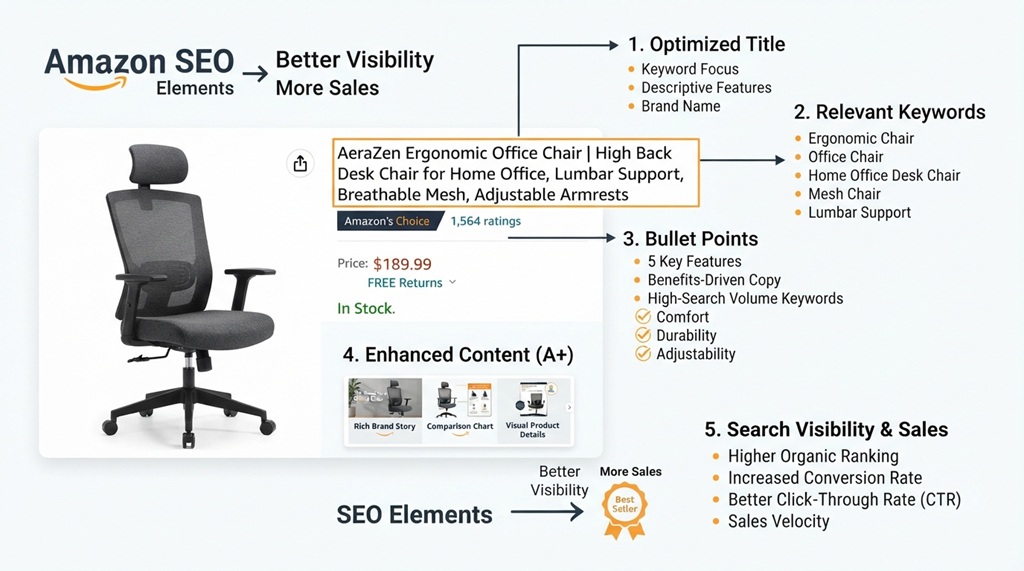
Amazon SEO is vital because it controls whether shoppers find your product at all. Without visibility, there are no clicks. Without clicks, there are no sales. Amazon runs its own search engine, called A9 (now shifting toward A10), and it ranks listings by relevance and performance not by how nice your product looks.
Many sellers assume good photos and a fair price are enough to win the sale. However, that’s only half the story. Even with perfect photos, a listing buried on page five rarely gets seen. In short, Amazon SEO is the bridge between a great product and an actual buyer.
Below, we’ll look at why Amazon SEO matters so much, how the algorithm decides rankings, and what you can do today to improve your own listings.
What Amazon SEO Actually Means for Your Listings
Amazon SEO means shaping your product listing so Amazon’s search engine understands what you sell and shows it to the right shoppers. It covers your title, bullet points, description, backend search terms, images, and even your pricing and reviews.
Unlike Google, Amazon has one clear goal: sell products. So, its algorithm rewards listings that convert well, not just listings that use the right words. As a result, Amazon SEO blends two things into one strategy keyword use and conversion strength.
A well-built listing tells Amazon three things clearly:
- What the product is
- Who it’s for
- Why shoppers should buy it over a competitor
When these signals are strong, Amazon trusts the listing enough to rank it higher.
How Amazon’s Search Algorithm Ranks Products
Amazon’s algorithm ranks products mainly by relevance and performance. Relevance means how well your listing matches what a shopper typed in. Performance means how likely that listing is to lead to a sale once someone clicks it.
Relevance Signals
Amazon scans your title, bullet points, description, and backend keywords to match your product with search terms. Because of this, listings with clear, accurate keyword use tend to rank higher for those exact terms.
Performance Signals
Amazon also tracks click-through rate, conversion rate, sales speed, and return rate. Even if a listing ranks for a keyword, it will eventually drop if it doesn’t sell Amazon favors results that make money over ones that just match words.
Why This Combination Matters
Since both factors matter, keyword stuffing alone won’t help you. Instead, you need relevant keywords and a listing that convinces people to buy. According to industry experts, sellers who skip conversion elements often see quick ranking spikes that fade fast once Amazon notices weak sales.
Why Amazon SEO Directly Impacts Sales and Visibility
Amazon SEO shapes sales because most shoppers never scroll past page one. Buyers trust Amazon’s ranking system, so they assume the top listings are the best choices. Therefore, if your product sits on page three, most customers simply won’t find it.
Search visibility also builds on itself over time. Higher rankings lead to more clicks. More clicks lead to more sales. In turn, more sales tell Amazon your product deserves an even higher spot. This creates a cycle that either helps you or hurts you.
Poor SEO triggers the opposite pattern. Low visibility leads to few sales. Few sales signal weak demand. That weak demand then pushes rankings down even further. Breaking this cycle later costs far more time and ad spend than getting it right from the start.
The Blueprint of a High-Converting, Search-Optimized Listing
Every top-ranking Amazon product relies on a seamless blend of visual authority and data-driven keyword architecture; overlooking a single element can stagnate both search visibility and sales conversions. While perfecting your main hero imagery and strategic keyword density builds immediate discoverability on the platform, your long-term success hinges on the software stack supporting your catalog. Evaluating which Amazon SEO tools work best today allows you to effortlessly uncover hidden search volume, track competitor keyword indexing in real time, and continuously refine your backend search terms to maintain a decisive ranking edge.
Product Title
Your title carries the most SEO weight on the page. It should include your main keyword near the start, along with key details like size, color, or quantity. Still, keep it readable a title stuffed with keywords looks spammy and pushes shoppers away.
Bullet Points
Bullet points highlight your product’s main benefits and secondary keywords. Each one should answer a real question a buyer might have, such as durability, use case, or what’s included in the box.
Backend Search Terms
Backend keywords are hidden fields where you add extra relevant terms that don’t fit naturally elsewhere. This space lets you target synonyms, misspellings, and related search terms without cluttering the visible listing.
Images and A+ Content
Images don’t carry keywords, but they strongly affect conversion rate, which Amazon’s algorithm tracks closely. For this reason, listings with lifestyle images, infographics, and A+ Content usually convert better, and that improved performance feeds back into stronger rankings.
Reviews and Ratings
Reviews shape both trust and ranking. Amazon favors listings with strong ratings because they signal reliable products and happy buyers, which supports steady sales over time.
Amazon SEO vs Traditional SEO: Key Differences
Amazon SEO and Google SEO share some basics, but they serve very different goals. Google SEO focuses on answering questions. Amazon SEO, on the other hand, focuses almost entirely on driving purchases.
| Factor | Amazon SEO | Traditional SEO |
|---|---|---|
| Main goal | Sell the product | Answer the search query |
| Key signals | Sales, conversion, reviews | Backlinks, content quality, authority |
| User intent | Mostly ready to buy | Mixed intent |
| Content style | Short, benefit-driven | In-depth, informational |
Because of these differences, sellers who apply pure content-SEO tactics on Amazon often fall short. Amazon simply doesn’t reward long explanations. It rewards listings that get shoppers to click “Add to Cart.”
Common Amazon SEO Mistakes That Hurt Rankings

Many sellers unknowingly hurt their own rankings. Fortunately, these mistakes are common and easy to fix.
- Keyword stuffing titles: This makes listings hard to read and can trigger suppression by Amazon.
- Ignoring backend search terms: Leaving this field empty wastes free ranking chances.
- Using low-quality main images: Blurry or non-compliant images hurt click-through rate.
- Skipping A+ Content: Brand-registered sellers who skip this miss an easy conversion boost.
- Changing prices too often: Frequent price shifts can confuse the algorithm’s performance tracking.
- Not updating listings regularly: Search trends shift, so static listings fall behind competitors who adjust.
Here’s one angle most articles skip: seasonal keyword drift. Search terms for the same product often shift wording every few months as trends change for example, “cooling towel” search interest can shift toward “gym towel” or “workout towel” depending on the season. So, reviewing your backend keywords every few months, not just once at launch, keeps your listing aligned with how people actually search right now.
How to Start Optimizing Your Amazon Listings Today
You can improve most listings within a few focused steps. First, start with the elements that carry the most SEO weight.
- Research keywords using real search data. Use Amazon’s own search suggestions or a keyword tool built for Amazon specifically.
- Rewrite your title so it leads with your main keyword and key product details.
- Update your bullet points to answer real buyer questions, not just list features.
- Fill your backend search terms completely, without repeating words already in your title.
- Improve your main and secondary images to meet Amazon’s rules and show real use cases.
- Monitor performance weekly and adjust based on click-through and conversion data.
Overall, small, steady updates tend to outperform one big overhaul, since Amazon’s algorithm rewards listings that show consistent, positive trends.
Frequently Asked Questions
What is Amazon SEO in simple terms?
Amazon SEO is the process of shaping your product listing so it ranks higher in Amazon’s search results. It includes keyword placement, images, pricing, and reviews, all working together to boost visibility and sales.
How long does it take to see results from Amazon SEO?
Most sellers notice ranking movement within two to four weeks after making changes. That said, full results depend on competition, category, and how consistently you optimize and monitor performance.
Does Amazon SEO work without paid ads?
Yes, organic Amazon SEO can drive sales without ads, though many sellers combine both. Ads can boost early visibility, while organic SEO builds a lasting ranking foundation over time.
How often should I update my Amazon listing for SEO?
Review your listing at least once every three months, or whenever you notice a drop in ranking or sales. Since search terms and competitor listings change often, static listings tend to lose ground over time.
Can bad reviews hurt my Amazon SEO ranking?
Yes, a pattern of low ratings can lower your visibility, since Amazon treats reviews as a trust and performance signal. That’s why addressing product issues quickly and encouraging genuine reviews helps protect your ranking.
Conclusion
In the end, Amazon SEO is vital because it determines whether shoppers ever see your product in the first place. A polished listing means little if it never reaches page one. By optimizing your title, bullet points, backend keywords, and images and by tracking real performance data you give your listing the best chance to rank well and convert.
So, treat Amazon SEO as an ongoing process, not a one-time task. Markets shift, competitors adjust, and Amazon’s algorithm keeps evolving. Ultimately, sellers who revisit their listings regularly tend to stay ahead of those who set it and forget it.